
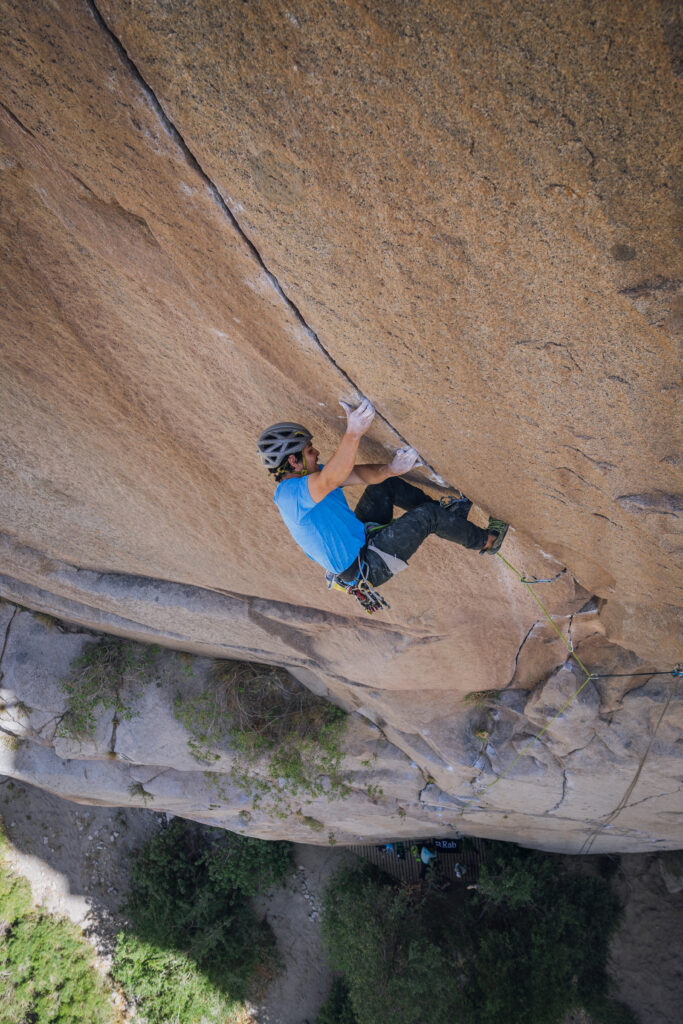
'What ropes are we taking?' 'No idea — bring yours and I'll bring mine.' That conversation lasted ten seconds. The rest of the day lasted considerably longer: 7 kg of rope in the pack, rope drag from the second pitch, and at every anchor a tangled mess — because one rope was 60 meters and the other 70, both were the same color, and neither was properly marked at the midpoint. Every time they belayed the second, it took twice as long to figure out which rope was which.
For single-pitch climbing, the rope decision is simple: a 60-meter rope, a belay device, done. But once you step onto a multi-pitch route, that logic stops working.
The routes are longer, there are rappels, the terrain is more varied, and the approach may take hours with a heavy pack. All of that completely changes the planning equation.
On a multi-pitch, the rope isn't just what protects you while climbing. It's also what you use to descend, what determines how much friction you fight on wandering pitches, and one of the heaviest and bulkiest items you carry all day. Choosing the wrong system isn't just an inconvenience — it can leave you without options halfway up the route.
This article explains the three rope systems that exist, the specific multi-pitch problems each one solves, and how to decide which to bring based on where you're climbing.
Four key factors that define the decision
Before discussing systems, you need to understand what actually drives the decision when climbing multiple pitches in a row. There are four factors that always come up — once you understand them clearly, choosing the right system becomes obvious.
1. The rappels
At the crag you can walk off or do a short rappel. On a multi-pitch, descending means rappelling multiple pitches in a row, often in terrain where there's no other option.
If you only carry one 60-meter rope, your maximum rappel is 30 meters — half the rope's length. On many routes that's not enough, forcing you to improvise, search for intermediate anchors that may not exist, or run out of options entirely.
2. Rope drag
Multi-pitch routes don't always go in a straight line. Every direction change — a piece on the left, the next on the right, then a traverse — builds friction between the rope and the carabiners.
With a single rope following that zigzag, there comes a point where the leader feels like they're dragging a loaded haul bag. On highly wandering pitches, this isn't just uncomfortable: it can make it impossible to belay the second from the anchor. Falls also become less dynamic due to reduced rope elongation.
3. Weight
A multi-pitch involves an approach, multiple climbing pitches, and a descent — often a night out as well. Every gram you carry in the pack you feel in your legs before you ever touch rock.
The rope isn't the heaviest item of the day, but it is one of the most obvious places to optimize — especially when the difference between one system and another can be over three kilograms.
4. How many people are in the team
Climbing as a pair is very different from climbing as a three-person team. With three climbers, the rope system needs to allow belaying two seconds simultaneously, one on each rope. That rules out some configurations and shapes the decision.
With those four factors clear, let's look at what each system solves — and where each one falls short.
System 1: The single rope — when it's still enough
A 9.5 mm single rope handles the most accessible multi-pitches: well-equipped routes, relatively straight lines, short descents or trail walk-offs from the summit.
If your goal is a sport multi-pitch in an area where routes are designed for rappels of 30 meters or less, a single rope is perfectly sufficient.
The problem appears when the route doesn't meet those conditions. Rappels of 40, 50, or 60 meters; pitches that wander significantly; or routes where you need more flexibility to adapt to the terrain — that's where the single rope falls short.
For those kinds of multi-pitches, you need a two-strand system. And this is where most climbers overcomplicate things.
There are two two-strand systems. One solves weight. The other solves rope drag. The difference matters.
System 2: Triple-certified rope + tagline — the minimum-weight system
This is the system most changing how climbers approach multi-pitch. The idea is simple: you carry a triple-certified rope — certified simultaneously as single, double, and twin — plus a 6 mm tagline.
Two strands that together weigh significantly less than any other two-rope combination. And you feel that weight difference in your legs on the approach.
How it addresses each multi-pitch factor
- Rappels: you tie the triple to the tagline, thread both through the anchor ring. Rappel 60 meters on the main rope, then pull the tagline from below to retrieve it. Full-length rappels, no searching for intermediate anchors.
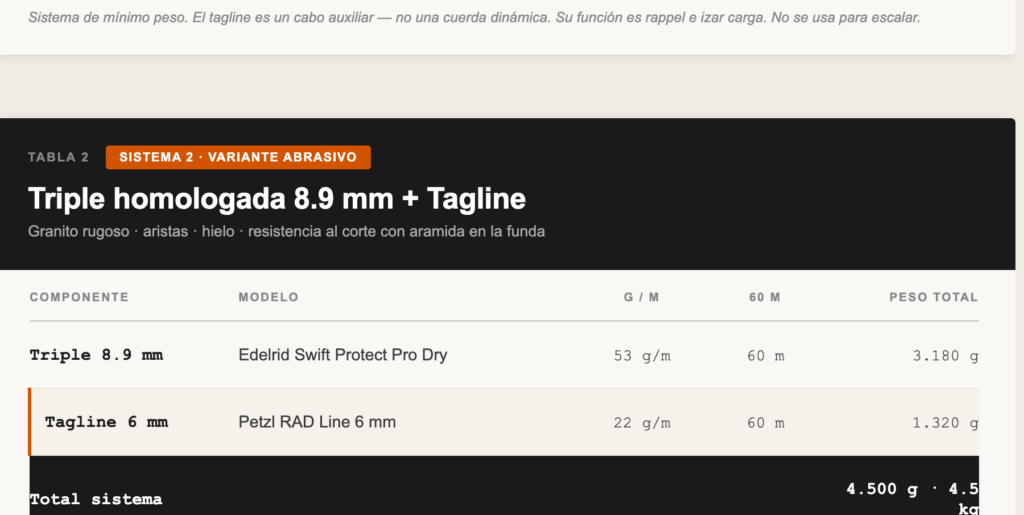
- Weight: this is where the numbers speak for themselves.

4.2 kg for a system that solves rappels and handles any technical multi-pitch with room to spare. It's hard to find anything more efficient.
Variant for abrasive terrain
If the terrain you're climbing has very abrasive rock — rough granite, edges that can cut the rope — there's a variant with aramid integrated into the sheath that gives cut resistance comparable to a 10 mm single. The system weighs 300 grams more, but offers real protection against one of the most common types of rope damage.
The real limitations you need to know
An important clarification about the tagline: it is an auxiliary cord, not a dynamic rope. Its function is rappelling and hauling — a backpack or gear you need to bring up to the anchor. It is never used for climbing.
That means two specific things:
- It doesn't solve rope drag on wandering routes — for that you need the double rope pair.
- If the main rope gets stuck on rappel and you only have the tagline available, ascending back up gets complicated.
These are real limitations to consider when planning the outing. They're not reasons to avoid this system — they're reasons to match it to the right route.
What if the route wanders a lot? Then you need a different system.
System 3: The double rope pair — the most versatile system
Two 8.0 mm double ropes is a widely used system for multi-pitch and alpinism. Its fundamental difference from the previous system: it allows belaying two seconds simultaneously, one on each rope. That makes it the necessary system for three-person teams.
How it addresses each multi-pitch factor
- Rappels: same as the previous system — join both ropes and you have 60 meters of full rappel.
- Rope drag: this is where the double rope pair really shines. You clip one rope to pieces on the left and the other to pieces on the right. Each rope travels in nearly a straight line, regardless of how much the route zigzags. The reduction in friction is dramatic and effective.
- Three-person team: you can belay two seconds simultaneously, one on each rope. You can also climb as three with two single ropes — perfectly valid — but the weight is significantly higher.
- Rappel safety: if one rope gets stuck, you have the other to ascend back up. That's a concrete advantage over the triple + tagline system.
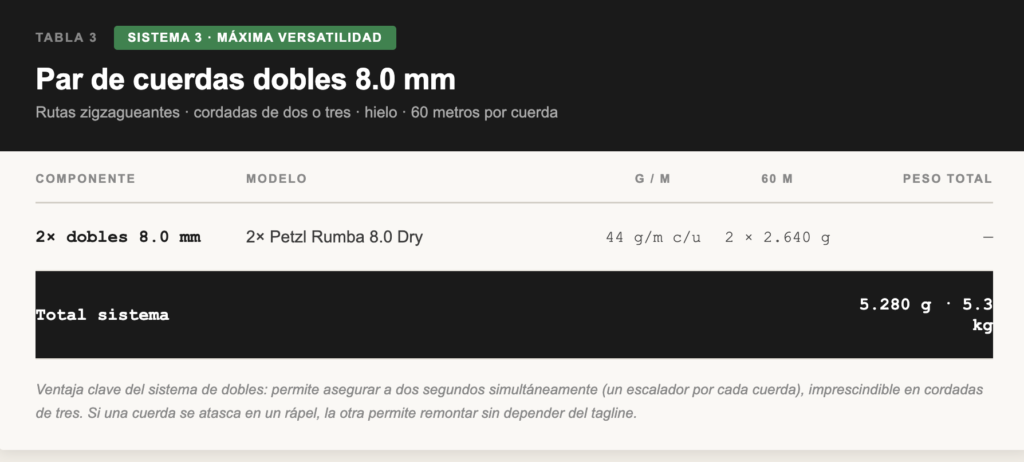
Is that extra kilo worth it compared to the triple + tagline system? If the route wanders significantly, or if you're a team of three: yes. Absolutely.
The system that weighs too much
There's a combination that comes up frequently among climbers planning their first multi-pitch: bringing two 9.8 mm single ropes.
The logic is understandable — they're ropes you already know, if one gets stuck you have the other, and it's perfectly valid for three-person teams.
The issue is the weight and rope drag, both for leading and belaying:
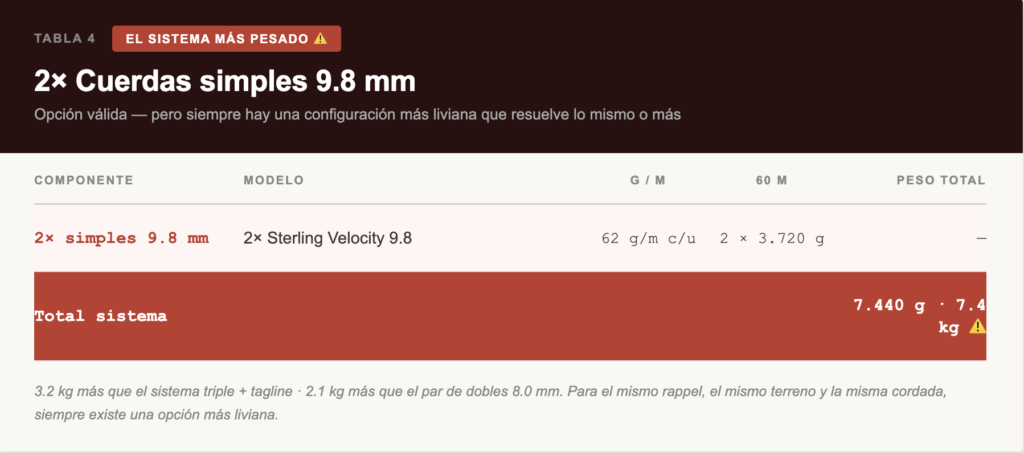
7.4 kg in ropes alone. That's 3.2 kg more than the triple + tagline system and 2.1 kg more than the double rope pair. It's not an incorrect option — it works. But for the same rappels, the same terrain, and the same team, there's always a lighter configuration that handles it just as well or better.
How to decide before leaving
Four questions that simplify the decision:
- How many people are in the team? If there are three, both the double rope pair and two singles allow belaying two seconds simultaneously. The difference is in weight and how they handle rope drag.
- What is the route like? If the line is relatively direct and rappels are within 60 meters, the triple + tagline system handles it with minimum weight. If the route wanders a lot, doubles manage rope drag far more effectively.
- How long is the approach? If you reach the wall after hours of hiking with a full pack, that extra kilo makes a real difference. The lighter system means you arrive at the rock fresher.
- Is the tagline enough, or do you need two full ropes? If the route is technical and there's a real chance of a rope getting stuck on rappel, having two full dynamic ropes gives you more options for ascending back up.
Summary table — all systems at a glance:
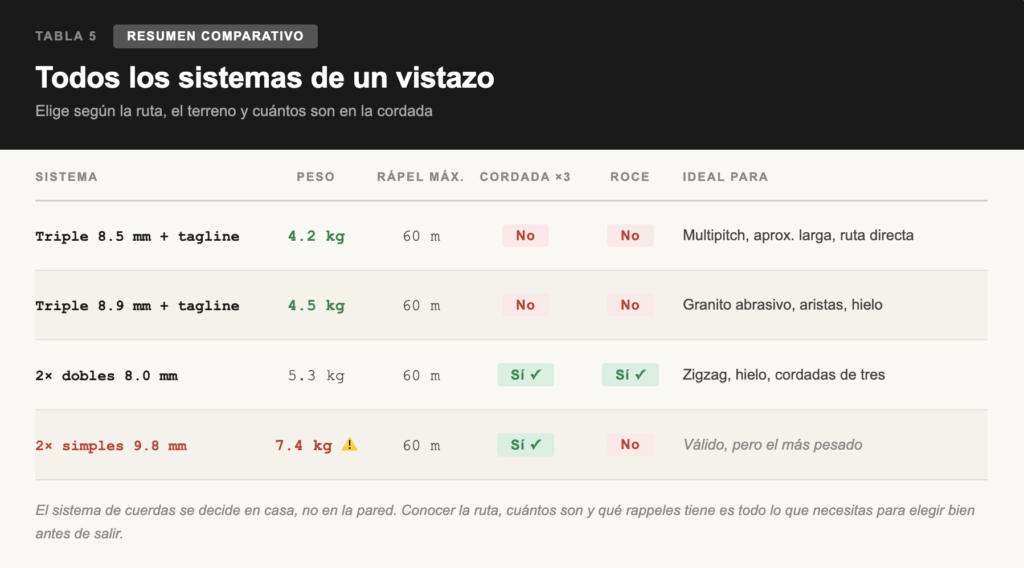
The rope system is decided at home, not on the wall
When you're already at the first anchor looking at the next pitch, it's too late to realize you don't have enough rappel length or that the rope drags too much to belay normally.
Thinking through the system before leaving takes no more than five minutes. Know the route, know your team size, know the terrain type, know how much rappel you need — that's all the information required to choose correctly.
The rope system is just one piece of multi-pitch planning. If you want the complete picture — access, approach, descent, gear, safety — we cover all of it in our multi-pitch planning guide.
→ INTERNAL LINK HERE: 'Planning a multi-pitch climb'»
The difference between a great day and a difficult day often has nothing to do with the grade of the route. It's in the decisions you made before leaving home.
Frequently asked questions about ropes for multi-pitch
Can I do a multi-pitch with a single 70-meter rope?
It depends on the route. A 70-meter rope gives you rappels of up to 35 meters, which covers many sport multi-pitches. But if the route has longer rappels or the terrain wanders significantly, you'll need a second strand. Check the route description before deciding.
What's the difference between a double rope and a triple-certified rope?
A double rope (half rope) is certified to be used in pairs — one clipped to each alternating piece. A triple-certified rope is certified simultaneously as a single, double, and twin. This gives it more versatility: use it alone as a single, in alternating pairs as a double, or as a twin by clipping both through each piece.
Can the tagline be used for climbing in an emergency?
No. The tagline is a 6 mm static auxiliary cord, not a dynamic rope. It is not designed to absorb falls. Its use is exclusively for rappelling and hauling. Using a tagline for climbing under any circumstance is a serious risk.
How long does a climbing rope for multi-pitch last?
It depends on use and terrain. A rope used regularly on abrasive granite will wear out faster than one used on compact rock. General rule: inspect the sheath before every outing and retire the rope if you find stiff spots, irregularities, or significant sheath wear. Dry-treated ropes last longer because the sheath absorbs less moisture.
Can I use ropes from different brands in a double rope system?
Yes, as long as both ropes have a current double certification (½). Brand isn't the determining factor — CE and UIAA certification is. What matters is that each rope is independently certified as a double.
Planning your first multi-pitch and not sure which system to bring?
At Andes to Pacific we guide multi-pitch climbs in the Cajón del Maipo, Torrecillas, Lo Curro, and Cochamó. Our guides advise you on exactly what gear to bring based on the route and your level — so you can focus on climbing, not on logistics.
"Amazing instructor! The course gives you everything you need to start trad climbing with confidence. I had already been trad climbing for 3 years, and in just two days of the course I learned far more than I thought I knew!"
— Benjamin Toro — Traditional Climbing Course student, Andes to Pacific
"Incredible!! I took the multi-pitch course and honestly a 10/10 experience. Alan is deeply committed to what he does and you can feel the care, dedication, and knowledge he puts into his courses!! So happy I did this with Andes to Pacific — tons of learning, real safety focus, and plenty of laughs too! Very grateful, 100% recommended."
— Fran Dacaret — Multi-Pitch Course student, Andes to Pacific
This article is part of a comprehensive climbing rope manual developed by Andes to Pacific for exclusive use by our students.
→ SEE COURSES AND GUIDED CLIMBS AT andestopacific.cl/cursos
 English
  Español