
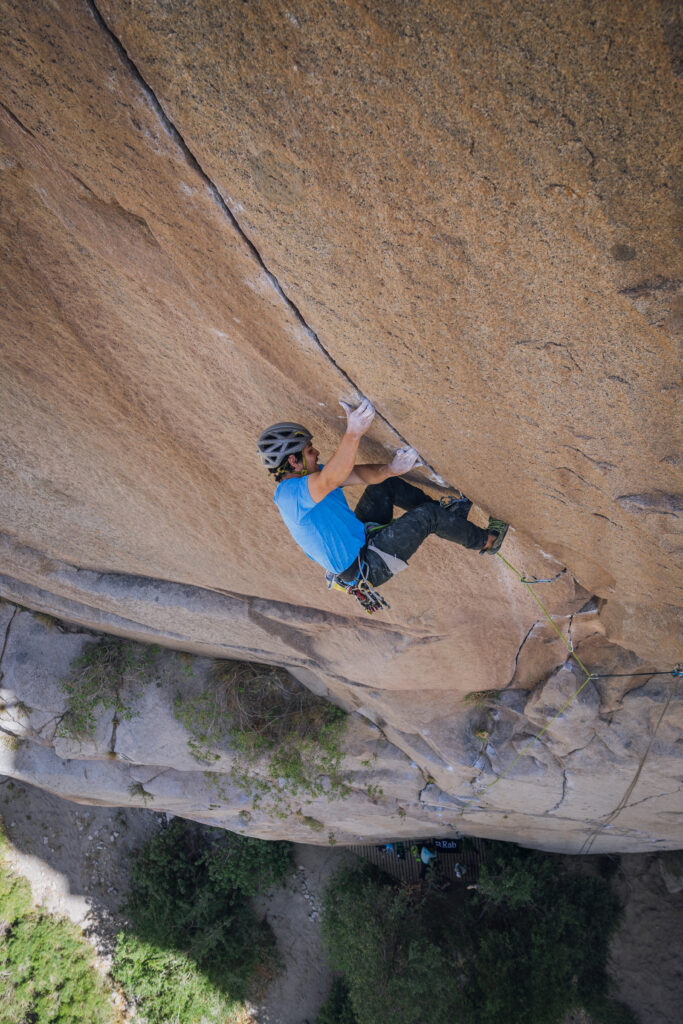
Preliminary note: Before you start reading, a brief clarification: this article is not a law, not an official regulation, and I don't claim to have the absolute truth. It's simply the opinion of one more Chilean climber.
It's Saturday morning and you arrive at Las Chilcas.
The sun hasn't hit the wall yet, but there are already plenty of people. Ropes hanging, routine warm-ups, greetings between teams that have known each other for years. The scene repeats at classic crags like La Mina, El Alfalfal, Silla del Diablo, Valle de los Cóndores, and Cochamó.
Every season there are more of us. Rock climbing in Chile has never drawn this many people. And that, in theory, is great news.
But there's something that needs to be said without much sugarcoating or romanticism: climbing outdoors is not a right. It's a privilege.
We share these spaces with others—landowners, wildlife, local communities, and other climbers. Respecting them is the only thing that keeps access open. The cost of not doing so is fatal, and we're already paying it in some areas.
In various parts of South America, crags are being closed due to the misconduct of a few.
I could give you the typical list of good and bad practices. What you should and shouldn't do. But if that's all you're looking for, this isn't that article.
This piece has a different goal. To make you a little uncomfortable.
Because it's very easy to fall into a comfortable trap: thinking that caring for the rock is someone else's problem—some abstract entity called 'the community.' Or simply waiting for some authority to one day come and impose order.
Wrong. It's your responsibility. And mine.
Taking ownership starts with the most basic thing: learning and applying the principles of Leave No Trace, understanding what kind of place you're entering, and above all, approaching crags with a lot more humility than we usually do.
But I want to flip this around.
The fact that climbing is growing worries many people. They see it as a plague. I see it as a massive opportunity.
We protect what we love. And every day more people are falling in love with the rock, becoming obsessed with it, finding something they're not willing to lose.
It's a double-edged sword.
Poorly managed, this wave of enthusiasm ends in destroyed ecosystems and landowners who are sick of us climbers.
Well managed, it's the largest group of stewards this activity has ever had.
The difference between the two is taking action. Getting informed. Leading by example.
Think about it. The newcomer doesn't leave trash, yell, or do things wrong out of pure malice. They do it because no one taught them. These rules of coexistence don't come in the box like equipment instructions, and they're not sent to you along with the crag coordinates.
That's where you and I have work to do. Not to go preaching at the base of routes. But to help people understand.
If we can make new climbers not just learn how to clip and climb, but to love and respect the place where they do it, then the sport's growth stops being the threat that closes the doors.
It becomes the force that protects them.
But to become that protective force, we first need to honestly look at the mistakes of the past. These are real consequences we've already earned through pure carelessness.
When we act as if the rock belongs only to us, we end up turning a place that should be amazing into something unpleasant.
Historically, due to poor behavior by climbers, some iconic crags have been permanently closed:
- El Arrayán (Chile): The iconic 'Magic Forest.' An incredible climbing area 15 minutes from Santiago. Why was it closed? Because mass access brought garbage, improvised trails, fights between climbers' dogs and the landowners' dogs, and poor treatment of the property caretakers.
- Socaire (Northern Chile): Here the definitive closure came directly with an official document. On September 3, 2024, the temporary closure of access to the Quebrada de Nacimiento was announced, under the territory of the Atacameño Community of Socaire. The official resolution clearly explains that the area lacks sanitary facilities and waste management systems, but the deeper reason is vital: this gorge is a fundamental water source on which the community depends. In the north, water is scarce and extremely sensitive. If climbers enter to camp without control, leave trash, bring dogs, or use the bathroom near the stream, they directly contaminate the water that supplies the entire village. How do we prevent this list of losses from growing?
Before you go, do your homework
The first good practice of a climber happens before leaving for the crag.
Every area has its fine print: some don't allow dogs, others charge an entry fee, require a prior permit, require you to keep gates closed, or have specific parking zones, etc.
The organization Acceso PanAm puts it as the mandatory starting point: knowing the access restrictions of nearby crags in advance. The British Mountaineering Council (BMC) summarizes it in a phrase everyone should have tattooed in their brain: "know before you go" (get informed before you go). Understand the ethics and conditions of the place you're visiting.
Seasonal closures: respect nesting season
Within prior research, there's one special case that's very important to identify: route closures for nesting birds.
Here in Chile this happens a lot. We have several bird species that come to nest precisely in the holes or cracks of the same routes we want to climb.
The logic here is simple: if we climb that route, the parents get scared, abandon the nest, and the chicks don't survive.
Respecting this is common sense and it's not forever. The birds won't live on the route their whole lives. It's a temporary process—the nest will be vacated in a few weeks and the wall will be there the rest of the year. In the meantime, there are plenty of options nearby.
If that route with the nest was your season project, it's a real shame. But you'll have to choose another line for a while, wait for the birds to leave, and then go back and try. The rock isn't going anywhere—but that egg has nowhere else to grow right now, and you have plenty of other options.
This sounds logical, but sometimes we forget. I've personally seen people removing nests from a hold at Las Chilcas just to keep climbing their project. It seems extreme, but it happens. And sacrificing local wildlife just to rush a send doesn't make much sense.
If you see a situation like this, it's worth having a conversation. It's not about starting a fight at the base of the route, but about helping people understand that the rock is shared with the surrounding environment. And that our send is not more important than those birds.
Take care of your waste
A lot of people don't deal with their waste out of laziness or ignorance. Because if you've been climbing outdoors for years and you're still leaving traces, it's no longer ignorance—it's something else.
Knowing how to go to the bathroom in nature is as basic a skill as knowing how to belay or tie a figure-eight.
To do it right you don't need elaborate gear or a fortune. Here's a practical, easy, and affordable recommendation—a small kit that fits in any pocket of your backpack:
- Dog waste bags: They're tiny, cheap, and take up no space.
- Toilet paper (just enough for the day).
- A small bottle of hand sanitizer
If you need to go: move away from routes and water sources—ideally about 60 meters. No shovel? No problem. Find a sharp-edged rock or a sturdy stick on the ground and dig a hole about 15 to 20 centimeters deep.
Do your business, cover it well with the same dirt, and the used toilet paper goes directly into the dog bag. Tie it off and put it back in your backpack. It's that simple.
The 'organic' myth
And while we're setting things straight, let's drop another bad habit: throwing banana peels, apple cores, or used mate leaves on the ground because 'it's organic and the earth absorbs it.'
Those scraps take months to decompose in dry climates, disrupt the diet of local animals, and turn the base of the route into a dump. If it came in your pack, it leaves in your pack. Everything. No exceptions.
At the base of the route: codes and common sense
For the day to be enjoyable for everyone, there are certain 'rules' of coexistence
Keep your gear organized, not scattered
The base of the route is often a small space, and sometimes a little exposed. Arriving and spreading your pack, shoes, food, and thermos everywhere takes up space from everyone. Keeping your things in one spot shows respect for others and makes moving around the area much safer and more comfortable. Let it show that we know how to share a space.
Routes are shared (even if you're a 'local')
It doesn't matter if you've been going to the same crag for ten years, if you bolted the line, or if you left your draws up because you're projecting. The rock belongs to everyone. If someone else wants to try the route where you have your project, leave the ego aside: talk it out, coordinate, share the draws if needed, and take turns. Open communication at the base of the route always improves the experience and avoids unnecessary bad vibes. Being stronger is not the same as having more right to climb.
The shade at the overhang at Las Chilcas
Let's think about a very specific case: the overhang at Las Chilcas on a hot weekend. The sun hits it directly around noon or 1 pm. The shaded hours are few and worth their weight in gold.
You arrive and there are four people in line for the same route you want to try.
The rule is the same for everyone: just because you have the route more dialed doesn't give you more right than the person trying it for the first time. Those people woke up early with the same drive as you—maybe even more.
If you want the route to yourself, the solution is individual: wake up earlier or go on a weekday. If it's a packed weekend, the best thing is to not create bad vibes. Talk to the others, organize efficient attempts so the wait isn't eternal, or simply have the flexibility to choose another route nearby. Learning to adapt to crag reality is also part of being a climber and sharing something that belongs to everyone equally.
Noise
This isn't about being a killjoy and demanding absolute silence; having a good time is part of the day. It's about being aware of our surroundings. If there's excessive yelling or too much noise at the base of the route, it can make communication between the climber and the belayer difficult.
A "Take in!" or a "Climbing!" that doesn't come through clearly up there can end in a fright or an accident. Tone it down if you see people trying to communicate, think about the other teams, and remember you're not alone at the crag. Respecting quiet also means taking care of others.
Also, if you're going to play music, ask first if it bothers anyone and avoid playing it too loud—you're in a natural environment with wildlife around.
Brushing holds
If you see someone projecting a route and carefully brushing chalk-covered holds, the least we can do if we climb it afterward is to brush it again on the way down. If you don't have a brush, set aside the embarrassment: ask to borrow theirs and do your share of the work. That way the route stays perfect for everyone to send!
Leaving the rope on the route
If your rope is set up for Top-Rope and you see that the team next to you wants to lead that same line, don't assume what to do. Ask before acting: "Hey, does it help if I leave the rope up for your attempt, or would you rather I pull it so you can lead?".
Gestures as simple as this completely change the energy at the base of the route and build a community that's a pleasure to be part of.
Other people's rest: not everyone has your schedule
There's another dimension of noise that doesn't happen at the base of the route, but when night falls at camp or high bivouacs.
Think about Cochamó or Valle de los Cóndores. You sent your route, it was amazing, you're relaxed and want to stay up talking, laughing, or playing guitar late. That's perfectly fine—it's part of the trip. But here's where empathy comes in: next to you there might be a team getting up at 4 or 5 in the morning for a big route. Their safety and energy tomorrow depend on being able to sleep tonight. Consider playing guitar or singing at hours that won't interrupt others' sleep.
Arriving late at night from a long route, or coming up from lower camps toward the high valleys and talking loudly until late, completely disrupts the life of the camp and the sleep of others.
The same happens when people arrive late by car to Valle de los Cóndores: parking next to the tents with headlights blazing, yelling and setting up camp while laughing while everyone else is trying to rest—that's not okay.
Nobody's asking for the campsite to feel like a cemetery at eight in the evening. It's simply about using common sense and understanding that we share the space. If you're going to stay up late or arrive late and there might be people sleeping, try to lower your voice, turn off the speaker and music—there will be more chances for that—walk quietly and respect others' sleeping hours.
Think about it in reverse: next weekend it could be you needing absolute silence to rest before risking your life on a wall before dawn. It's good for us to treat each other the way we'd want to be treated.
Traffic on multi-pitch routes
When you get on a multi-pitch route, the coexistence dynamic changes completely. Here common sense applies in two directions:
- If you're the slow rope team: If you notice that the team behind you is moving noticeably faster, the good option here is to let them pass. There's nothing wrong with moving at a different pace. The healthiest and most courteous thing is to ask them at the next anchor if they'd prefer to go ahead. Letting them pass prevents them from getting frustrated and, at the same time, takes the annoying pressure off you of having someone rushing you while you climb.
- If you're the fast rope team: If you arrive at the base of a multi-pitch and see there's already traffic and several teams on the wall, use some judgment. Don't start the route with the mindset of "we're fast, we'll pass everyone". If the route is already overcrowded, change your itinerary or choose another multi-pitch. Going in to pressure others or pass people on a multi-pitch only adds tension and danger to a situation that's already complex. Think twice.
Safety and competence: Knowing what you don't know
There's one last point that has nothing to do with cleanliness, but with something much more basic: safety and your responsibility regarding your own knowledge.
It's essential to know what you don't know. If you still haven't mastered belaying or lack experience to lead on rock, admit it with maturity. There's nothing wrong with being in the learning phase—we all start from zero. The real problem starts when you try to improvise in a wild environment.
Going out to try your luck without the right skills doesn't just directly endanger your rope team's lives; it puts the entire crag in a terrible situation. If you make a serious mistake and an accident happens, besides the serious harm that could come to you or your partner, everyone who came to enjoy their day will have to stop climbing to assist in the rescue. Not counting the psychological trauma you leave on the witnesses. Your irresponsibility drags the entire community with it.
The danger of trad climbing without knowing
And a huge warning about traditional climbing. If you're going to climb trad without really knowing how to place gear, stop for a moment! Going to the rock with a borrowed rack doesn't make you a trad climber. This gear doesn't work by magic—if you place it wrong because you don't have the knowledge, it will pop out one by one if you fall.
Taking a big fall on a traditional route and having all the gear blow with you doesn't just put you and your partnerat serious risk—it creates horrible accidents at the base of the route. And we're back to the root problem: a complex rescue due to recklessness is the perfect excuse for landowners or authorities to impose a permanent closure.
If you feel you're lacking the skills, ask for help from someone with real experience or take a course with a certified professional. Your life, your partner's, and the peace of mind of the entire crag are absolutely worth that investment.
Are we ready for 'free access'?
Let's think about Valle de los Cóndores: a world-class basalt paradise where in summer several hundred people climb per day. There's no gate, no ticket, no restrictions. It is, in practice, a free mountain.
And what do we see there? Exposed toilet paper, accumulated garbage, and disasters after party weekends. Far from any romanticism, objective reality tells us something uncomfortable: perhaps we're not yet ready to have these free mountains.
But the same valley showed us that growth is possible. When the threat of an Enel project to install high-voltage towers in condor nesting zones appeared, the local climbing community understood something profound: it was no longer about bolting routes for ego, but about preserving, conserving, and maintaining the place. That's the real leap from being a simple 'user' to becoming an agent of change.
In Nordic countries, free access is the norm, but it didn't fall from the sky. In Sweden, the right known as allemansrätten gives you access to almost any terrain, but under a brutally simple premise: "Do not disturb, do not destroy". The only price paid for entry is respect.
Europeans take care of the mountain because they have a mountain culture. They know that free access is a contract where the right and the duty are the same thing. In Chile, my impression is that many times we experience free access only from the emotional side: "I want free access so I can go whenever I feel like it", not from the responsibility of "I take care of it". And those are very different things.
It starts with you
That's why we go back to the beginning. Let's not wait for some invisible authority or 'the community' in the abstract to solve this. It starts with you.
The next time you go to the crag, know the access rules, apply Leave No Trace, build your waste kit, pack out your organic waste, turn down the music, respect the landowners and the other climbers at the crag
And then take the step that truly changes things: become someone who leads by example, without preaching.
Go from being a mere spectator to an active participant. The future of our crags is decided by what each of us does—and doesn't do—every time we arrive at the base of a route.
 English
  Español