
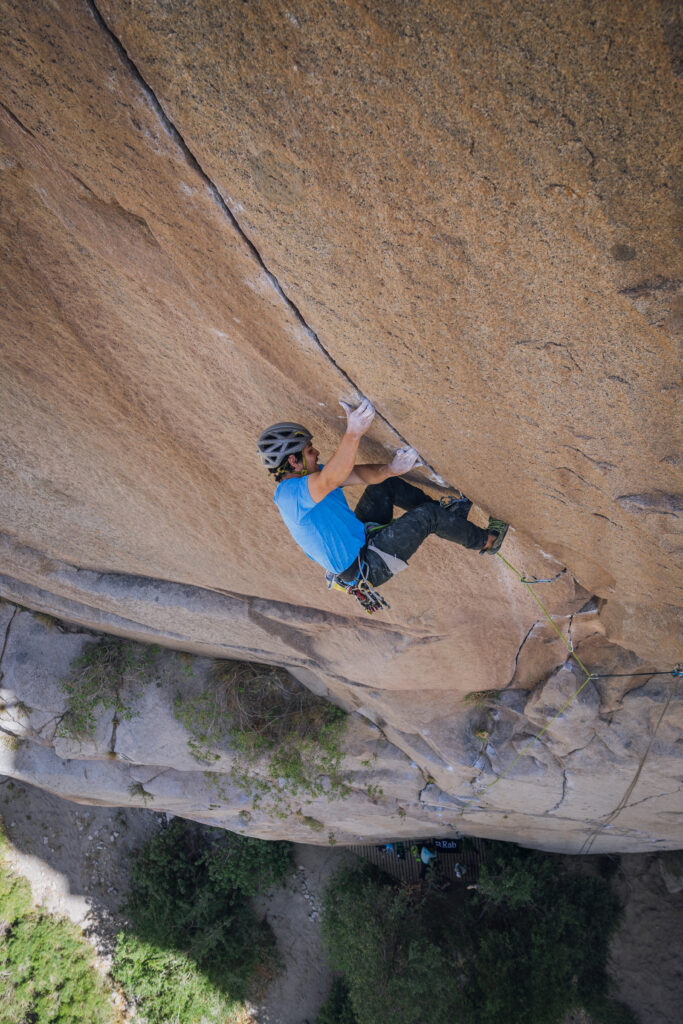
Many climbers bail off multi-pitch routes not because they're tired… but because of poor organization.
They lose time in slow transitions, tangled ropes, and improvised anchors.
That doesn't just exhaust you — it can compromise the outing and put you in dangerous situations.
But it doesn't have to be that way. In this article we talk about how to be more efficient in every technique.
What Does Efficiency Mean on a Multi-Pitch?
Being efficient is not the same as going fast. It's not about rushing on the wall.
It means having clarity about what you're going to do, knowing your techniques perfectly, using your gear intelligently, and minimizing unnecessary pauses.
It's the fluidity you see in experienced teams: they move without rush, but without hesitation.
Every action has a purpose. Every movement, an order. That's efficiency.
Every Technique Adds Up… and Time Multiplies
On a multi-pitch day, you'll repeat several key techniques:
- Building anchors
- Climber transitions at each pitch
- Rope management
- Belaying from above
- Setting up rappels
- Gear organization
If you take just 1 extra minute per technique across 6 techniques, done 10 times on 10 pitches… That's already 1 extra hour! And honestly, when you're not efficient, you're probably losing much more than 1 minute per technique.
What if your partner is also slow? What if the terrain is complex? What if you don't know the route and lose time navigating?
That's when those minutes start turning into one, two, or more hours of difference in your day out.
Inefficiency doesn't just slow you down: it drains you mentally, exhausts you, and exposes you longer to the terrain
Where Is Time Most Often Lost?
These are common situations where efficiency can make a radical difference:
- Building anchors without a defined method
→ Having to improvise each time adds up to valuable seconds or minutes. - Belaying from above with uncertainty or poor organization
→ A poorly rigged Reverso, disorganized station management, or tangled ropes can slow everything down. - Climber Transitions
→ Not having a clear method for switching climbers at each pitch can cost several minutes.
- Unclear communication between partners
→ Not having a clear command system — shouting, repeating instructions, or misunderstandings — can consume a lot of time.
How Can I Be More Efficient?
🔧 Practice your techniques on controlled terrain
Building anchors, making transitions, setting up a rappel, managing ropes at the station — all of that can be practiced before going on a real multi-pitch.
🎒 Organize your gear by function
There's a big difference between carrying everything dangling and having a logical, functional organization.
📣 Establish clear commands with your partner
We recommend this system:
Climbing!: I'm starting to climb.
Climb!: I'm paying attention and belaying you.
Take!: take in rope until you have tension on me.
Tight!: I have tension on you.
Slack!: give me rope.
Off belay!: I no longer need you to belay me — release the belay system.
Belay off!: response — I've released the belay, you're off belay.
On belay!: I've built the anchor, you're in the belay system, I'm belaying you and you can climb whenever ready.
When you lead a pitch and reach the anchor, you don't need to shout "anchor", "self-belay", or "safe". Why? Because those commands can create confusion if you're not yet fully anchored.
The most safe and efficient approach is to wait until you've built the anchor, clipped correctly into the master point with your personal anchor, and are 100% ready — then shout: "Off belay!"
That's the only clear command that tells your partner they can take you off belay. Until then, they must keep you on belay.
This prevents misunderstandings that could put the team at risk.
Can you use other commands? Yes — but both you and your partner need to be crystal clear on what each command means.
🧠 Have a defined system
Define clearly how transitions will go, who's climbing which pitch, and which anchor systems you'll use based on your gear and the terrain.
Efficiency Is Also Safety
When you take longer, you're exposed more. Fatigue builds, concentration drops, and mistakes become more likely.
An organized system doesn't just save time — it also protects you.
Efficiency Starts with Planning
And it's not just about what you do on the wall — efficiency starts at home.
- What multi-pitch are you doing?
- What specific gear do you need?
- What will the weather be?
- What's the escape route if something goes wrong?
👉 Check out this article on how to plan a multi-pitch outing step by step:
🔗 Multi-Pitch Climbing Planning Guide
Want to Learn Multi-Pitch Climbing with Efficiency?
At Andes to Pacific we work through all these concepts on real terrain.
In our courses and guided outings you don't just learn to climb: you learn to climb well, with judgment and efficiency.
 English
  Español