
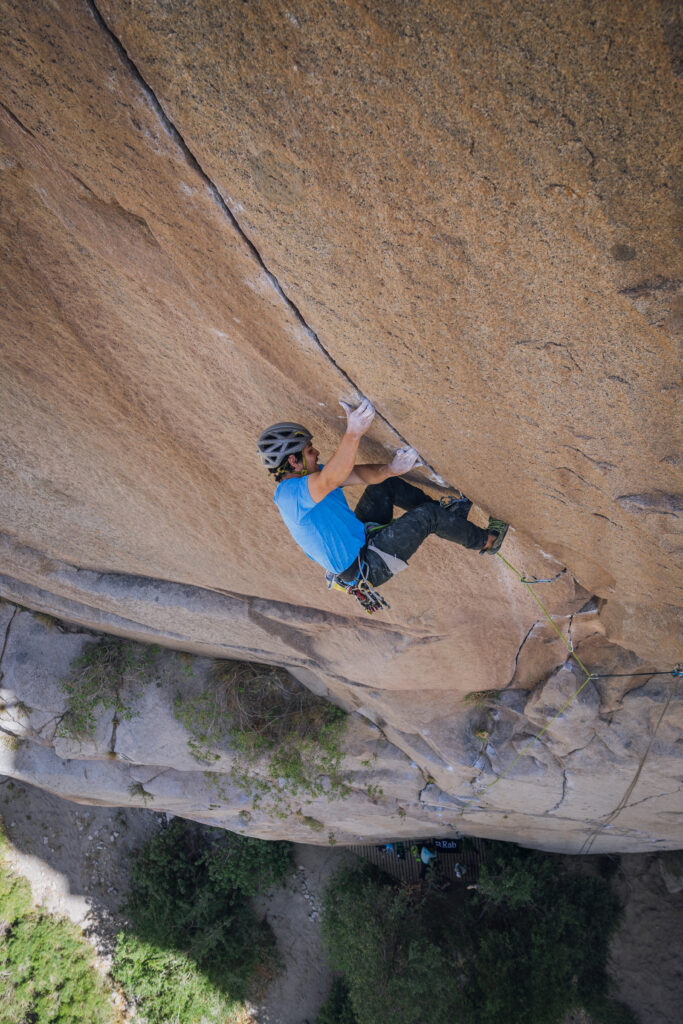
When it comes to multi-pitch climbing, gear planning is everything. You can't improvise. You need to go light — but without leaving anything behind. Here's a detailed guide to the minimum essential equipment you should consider before tackling your next multi-pitch route.
1. Personal Base Gear
- Harness, helmet, rock shoes, and chalk bag
This is your foundation. Everything must be in perfect condition and comfortable for long days on the wall.
- Personal anchor with locking carabiner
Ideally an adjustable system like a PAS (Personal Anchor System). Essential for safely attaching to anchors and extending your rappel system on descents.
You can also use your rope with a clove hitch to a locking carabiner.
- Anchor system: 120 cm sewn Dyneema sling + locking or non-locking carabiner.
At Andes to Pacific we recommend this configuration for its simplicity, light weight, and efficiency..
A sewn 120 cm Dyneema sling, paired with a locking or non-locking carabiner, allows you to build anchors quickly and cleanly — especially useful on sport multi-pitch routes.
Here's an example of how to use it https://www.instagram.com/p/DH6_AneSv-8/
That said, other valid anchor configurations exist depending on preference or technical requirements:
- 7 mm × 5 m cordelette: can be used to build a quad anchor or a sliding-X with spaced bolts.
- 180–240 cm sling: also useful for quad anchors or a sliding-X with spaced bolts.
These options are safe but can be bulkier and heavier. If you're looking for light weight, speed, and safety, the 120 cm sewn sling is your best option.
- HMS carabiner
This will be your master point in most anchor configurations.
- Friction hitch sling or cordelette: Essential for backed-up rappels and safety maneuvers.
- Dedicated locking carabiner: To pair with your progress-capture device.
2. Belay and Rappel System
- Reverso or ATC Guide-style device: Essential on multi-pitch for its guide-mode belay function. Make sure it's compatible with thin ropes if you're using double or twin ropes.
- Extra HMS carabiner: Required to operate the belay device.
- Type B locking carabiner: Complements your system for specific configurations.
- Grigri
3. Basic Self-Rescue Kit (Highly Recommended)
- Microtraction or similar: For ascending a rope or building hauling systems.
- 7 mm × 5 m cordelette: Versatile and essential for multiple maneuvers — abandonment, self-rescue, load transfer, etc.
- Tibloc or lightweight ascender: Very useful for self-rescue or rope ascension.
- Climbing knife: Can be critical for cutting an escape cordelette or rope.
- Pulley: For building hauling systems.
- Garmin inReach: Satellite communication and SOS system. In remote terrain it can make all the difference — click Garmin inReach for a full article on how it works.
5. Shared or Rope-Team Gear (route-dependent)
- Set of quickdraws (minimum 12–14): Some routes need up to 18. Bring some longer ones to reduce rope drag.
- Single or double rope (minimum 60 m): Depends on the route and descent plan. Plan this carefully.
- Small backpack (20–30 L): Bring at minimum a warm layer, water, food, headlamp, and first aid kit.
Additional Tips
- Check the specific route description before prepping your gear. Some require trad protection, others only quickdraws.
👉 Multi-pitch routes to get started near Santiago - Plan ahead. Assess weather, logistics, the route, and rappels.
👉 Complete planning guide for multi-pitch climbing - Practice your maneuvers before heading out: transitions, guide-mode belaying, rappels with backup.
- Don't underestimate weight. Every gram counts. Going light and safe is an art.
Ready to climb a multi-pitch?
If you want to take your climbing to the next level, we invite you to:
👉 Take a multi-pitch climbing course with us.
👉 Join a guided outing with certified professionals.Learn more on our website, in the courses or guided outings.
The wall is waiting… but always with preparation, knowledge, and the right gear!
 English
  Español