🧗♂️ What Are Friction Knots?
The friction knots or self-locking are essential tools in climbing — they allow you to secure a rope temporarily or permanently for a range of techniques: from a rappel backup to rope ascent to rescue maneuvers.
These knots work through the friction generated between the main rope and the cord (or the rope itself), allowing the system to lock or slide depending on the tension applied.
Their principle, more than "friction between two ropes," is what many Canadian and US guides call a rope grab: a mobile anchor point that grips the rope through friction. In other words, a reliable way to "grab" the rope without mechanical devices.
The goal isn't to memorize individual knots — it's to understand when and why to use each one.
A Prusik, a Machard, or an Autoblock may look similar, but they behave differently depending on rope diameter, cord type, the specific technique, or even environmental conditions like snow or moisture.
So rather than looking for the best knot, what matters is identifying the most appropriate knot for the situation.
At Andes to Pacific we teach exactly that: the reason behind each technique.
When you understand how a knot behaves, what makes it more or less efficient, and what factors influence its performance, you stop repeating techniques and start making informed decisions on the wall. That deep understanding is what transforms a climber into someone truly autonomous and safe.
While there are many types of friction knots, in practice three of them cover almost every technique safely and efficiently:
the Prusik, the Machard and Double-Loop Machard or Autoblock.
So rather than filling your head with knots, what matters is understanding these three well, knowing their pros and cons, and knowing when to choose each one based on the technique and the conditions around you.
🔸 Prusik
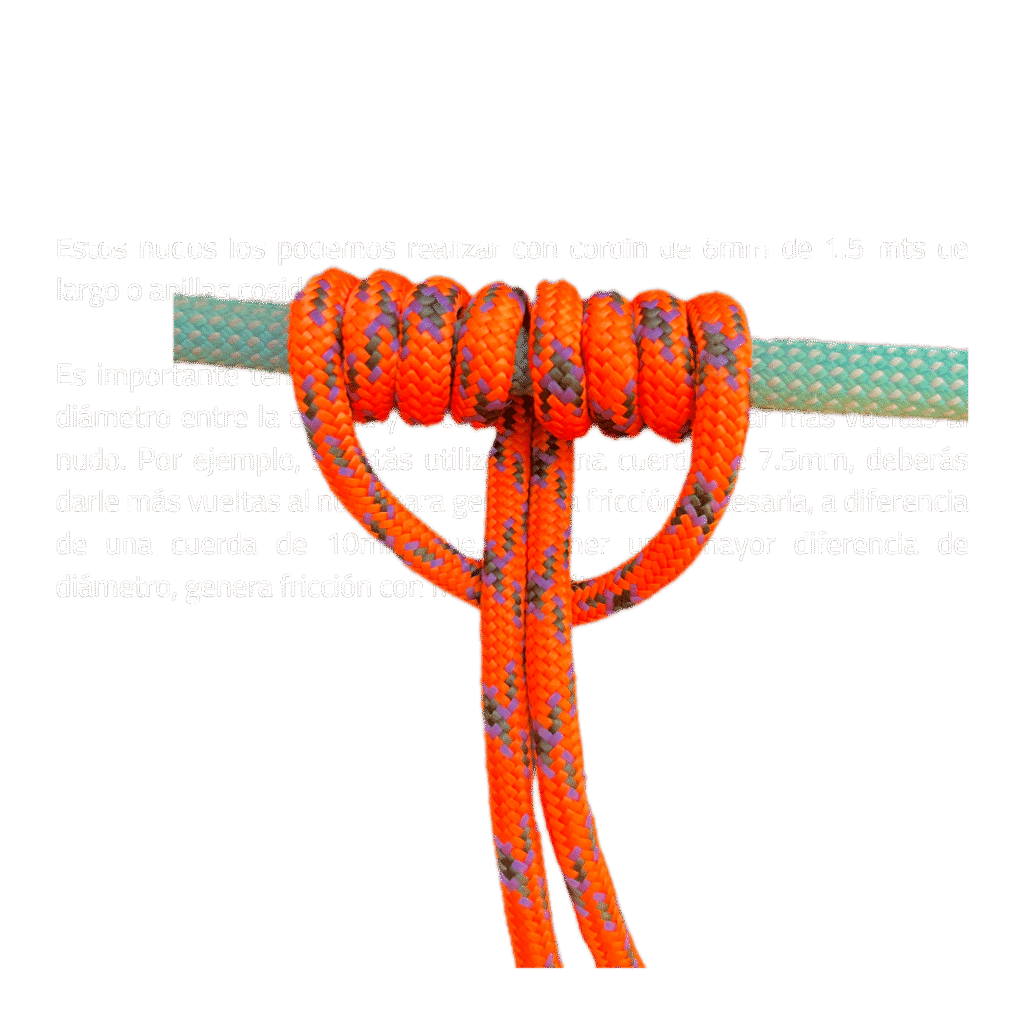
Uses:
- Fixed-rope ascent.
- Securing a rope.
- Rappel backup.
- Extendable safety line.
- Rescue techniques.
Pros:
- It's the self-locking knot that generates the most friction on the rope.
- Holds heavy loads without slipping.
- Locks in both directions, making it very reliable for rescue or ascending techniques.
Cons:
- Once loaded, it's hard to slide.
- Difficult to release under load.
👉 Ideal when maximum security and grip are needed — controlled ascents or securing heavy loads. Less practical for techniques requiring fluid movement.
🔸 Machard

Uses:
- Fixed-rope ascent.
- Securing a rope.
- Rappel backup.
Pros:
- Slides better than the Prusik, making repetitive movements easier.
- Grips the rope well , though not as strongly as the Prusik.
- Easier to release under load.
Cons:
- Only locks in one direction.
- Performs worse in snowy or wet conditions.
👉 An excellent option for those seeking a balance between control and fluidity. Ideal for rappels or rope progressions where a knot that releases easily is needed.
🔸 Autoblock

Uses:
- Fixed-rope ascent.
- Securing a rope.
- Rappel backup.
Pros:
- Very quick to tie.
- Locks in both directions.
- Easy to release even after being loaded.
Cons:
- It's the self-locking knot that generates less friction than the others.
- Sometimes slow to catch the rope.
- Must be used carefully in snowy or wet conditions.
- Can come undone if not properly dressed.
👉 It's the preferred choice for rappel backups, where the knot needs to release easily when used as a third hand. However, it's not ideal in conditions requiring maximum friction.
🎯 Conclusion
Knowing how to tie a knot is one thing. Knowing when to use it and why is something else entirely.
Each one has its place, its context, and its specific advantages. That's why, at Andes to Pacific we teach from the logic of the technique: understanding each knot's behavior, analyzing the material, rope type, and real mountain conditions.
Because when you master the fundamentals, your safety depends not on luck, but on well-informed decisions.
📍 Learn the reason behind every technique.
👉 Reserve your spot in our next climbing course
 English
  Español